
The American Dream: Still a Reality?
The idea of the American Dream has become central to our national identity, drawing from the writings of the Founding Fathers, who believed that people have the right to thrive by their own merits. Economic freedom and upward mobility are core components of this ideal. For Louisianans, however, the American Dream may be less accessible than it is for Americans living in other states.
Earlier this year, a report by the Pelican Institute for Public Policy and the Archbridge Institute found that Louisiana ranked dead last in supporting upward mobility when evaluating broad factors such as entrepreneurship and economic growth, institutions and the rule of law, education and skills development, and social capital. In the subcategories of taxes and business dynamism, Louisiana ranked particularly low.
There are several clear paths for economic improvement: eliminating the state income tax, broadening the sales tax base to lower rates, allowing parishes to exempt business inventory from property taxation, and establishing a government growth limit. While Louisiana has made significant progress in economic freedom and competitiveness by reducing the state income tax to a flat rate of 3%, eliminating the state income tax entirely—as other, more competitive SEC states such as Texas, Tennessee, and Florida have done—would further improve outcomes for Louisianans.
Louisiana residents are also burdened with the highest combined statewide and average local sales tax rate in the country, at 10.1%. The sales tax code continues to exempt many services, narrowing the tax base and limiting the state’s ability to reduce rates. At the same time, Louisiana taxes business inventory—a levy that applies regardless of whether a business is profitable. As the Tax Foundation has noted, this non-neutral tax structure disproportionately burdens inventory-intensive businesses and distorts economic decision-making by encouraging inefficient inventory timing and location strategies. Louisiana voters will have the opportunity to repeal this policy and allow parishes to reduce or opt out of levying the tax in an upcoming statewide election in May of 2026.
Reining in the size and spending of state government would allow tax burdens to lessen—some to disappear entirely—while also protecting individual liberty. This is the aim of the Government Growth Limit (GGL), which would tie state spending to objective benchmarks such as population change and inflation. Louisiana continues to increase state spending despite an overall trend of population decline. During the 2026 legislative session, lawmakers can prioritize the enactment of a GGL to correct this harmful trend and promote long-term prosperity.
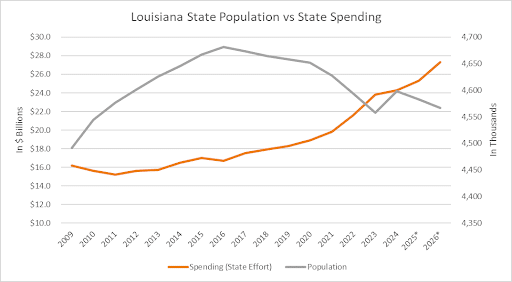
Source: Louisiana Division of Administration State Budgets
Keeping and building upon the fruits of one’s own labor is inseparable from the American Dream. James Madison addressed this principle in a short essay on property, in which he defended the right to hold not only material possessions but also immaterial rights—such as conscience, communication, and opinion—as one’s own. On the government’s obligation to uphold individual property rights, Madison wrote (National Gazette, March 27, 1792):
A just security to property is not afforded by that government, under which unequal taxes oppress one species of property and reward another species: where arbitrary taxes invade the domestic sanctuaries of the rich, and excessive taxes grind the faces of the poor;… in violation of that sacred property, which Heaven, in decreeing man to earn his bread by the sweat of his brow, kindly reserved to him, in the small repose that could be spared from the supply of his necessities
The Louisiana government should not deprive residents of their hard-earned dollars by maintaining the status quo. Instead, lawmakers can enact bold reforms to make the American Dream more of a reality for everyone this new year.